Today there are many ways businesses can improve their inventory strategy, and perhaps none is as effective as using a smart warehouse management solution with barcodes and QR codes. Whether you are a B2B e-commerce company or a business looking to tighten up its warehouse management system, barcodes and QR codes are among the lowest-risk, highest-benefit upgrades you can make to your warehouse system.
Barcoding your inventory can save you the time, money and hassle of tracking and managing your products manually. When used with inventory management software, barcodes give you instant access to the status of your inventory, including description, availability, cost and location.
Use mobile devices and barcode scanners (or RFID tags) for every warehouse operation - inventory, incoming shipments, packing orders... - to automatically receive, validate, track movements and trace goods easily, skipping manual data entry, preventing human error and increasing inventory accuracy.
Discover how the following large businesses successfully use barcodes and QR codes to manage their warehouses.
Contents
2. 7 reasons to implement barcode-based warehouse management
3. What do you need to prepare to use a barcode system?
What is a barcode?
A barcode is a visual representation of data using lines and spaces that can be read by a digital scanner. Introduced in 1951, barcodes were not widely adopted until supermarkets began automating grocery checkout in the mid-1970s with Universal Product Codes (UPC).
Barcodes are effective at accurately identifying products and ensuring everyone has access to them.
A UPC barcode identifies two pieces of information: the product and the manufacturer
UPC is a one-dimensional barcode: Data is encoded using different widths of parallel lines and the spaces between them.
Two-dimensional barcodes: are square, like QR codes, or rectangular and made up of many dots, and can store more information.
Today there are more than 30 major barcodes with different applications, from the Bookland EAN-13 barcode that embeds product, publisher and pricing data on the back of books to single-use barcodes with shipping information.
Stock keeping unit (SKU) barcodes are similar to UPCs - both identify specific products - but individual retailers create and use them to control their own inventory.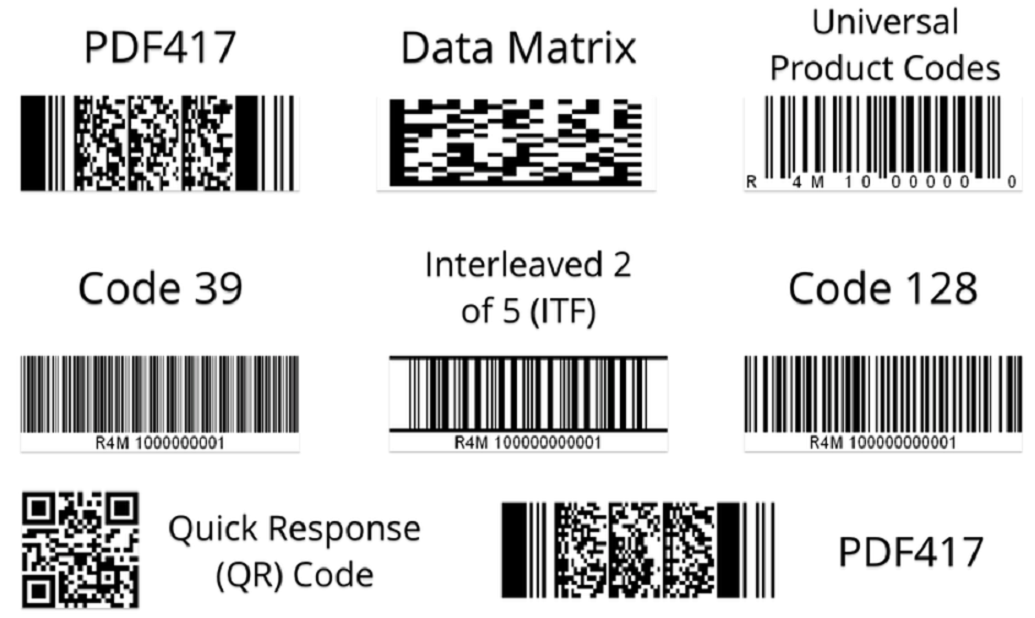
Some common types of barcodes/QR codes
7 reasons to implement barcode/QR code warehouse management
There are several reasons why using inventory management software together with barcodes will not only improve your day-to-day operational performance but also boost your profits in the long run.
Case study: using barcodes and QR codes for smart warehouse management
1) It's simple
You may have the misconception that an Excel spreadsheet is the easier route. Manually entering the SKU of hundreds of items every day is anything but simple. Easy is when the items in your warehouse have unique barcode labels, information can be added to them, and the related product data can be viewed with one quick, simple scan. Inventory can be displayed in real time, at any moment, with a single scan.
2) Cost-effective
In many industries, barcodes provide automatic product identification and extremely fast data deployment. Although the complexity of the application varies, each barcode label costs only a few hundred dong. You can reduce costs, cut training time and labor, and increase productivity. It also reduces the capital cost of carrying excess inventory, because knowing exactly the status and quantity in stock helps you avoid over-ordering.
3) Barcode technology is readily available
We all know how quickly technology advances, and barcodes are no exception. The technology is readily available and can be implemented by anyone. The sooner your business adopts a barcode inventory management system, the better. Too many businesses wait until they face missing, lost or damaged inventory before choosing to start managing their inventory seriously. By then it has already cost them billions of dong. Following these simple steps will not only save your company time and money but will ultimately improve customer satisfaction.
4) Barcodes eliminate errors
Handwriting or manually typing numbers can be difficult; barcodes are a breeze. For every one thousand keystrokes a person makes, there are on average 10 errors.
With a barcode scanner, however, for every 10,000 scans only one error occurs. It eliminates delayed deliveries caused when staff have to search manually for items that may be out of stock or misplaced. In addition, data errors can cause overspending when too much inventory is ordered.
5) Accurate inventory tracking
Knowing where your inventory is at all times is crucial for any business. It not only reduces overselling and stockouts but also helps provide an accurate audit trail for all your inventory.
Barcode scanners can be used to carry out periodic cycle counts. So when your picking team has downtime, they can use their scanners to quickly count sections of the warehouse. That means you have more accurate inventory figures, more often.
6) Saves time
When the inventory in your warehouse isn't organized with an automated system, your staff spend too much time entering data or recording inventory, as well as physically searching for items in the warehouse. A barcode warehouse system speeds up warehouse operations. This can be especially helpful during busy periods such as Black Friday, holidays and Tet… because you can handle the increased order volume without hiring temporary staff.
7) Barcodes provide security
Barcodes are traceable and fully auditable, strengthening your ability to prevent theft, giving peace of mind and clearly reducing losses and legal liability.
What do you need to prepare to use a barcode system?
You've decided to use barcode warehouse management software. Here is what you need to prepare your business in terms of tools:
Barcode scanners (including smartphones and tablets) depending on the size of the business's warehouse.
Computers, including desktops or laptops.
A screen for warehouse dispatching (with a smart warehouse solution that supports visual warehouse management via a warehouse layout).
Khám phá ngay: Smart warehouse management with a visual warehouse map.Barcode printers.
Barcode labels.
Barcode or QR code generation software (with a smart warehouse solution that supports automatic code generation).
An inventory list, ideally maintained digitally, such as in an app.
Although almost all warehouse management software lets you use traditional barcode scanners, smart warehouse management solutions let you use your existing smartphones and tablets to scan codes.
The same goes for barcode printers and labels. You can actually create custom barcodes and QR codes right in the smart warehouse management software, then print them on labels with a printer.
You can also add lots of details, such as your company's logo, colors and product information, right on those custom labels. And you can choose the shape and size of the labels.
Conclusion
If you cannot accurately track the quantity and location of the items in your warehouse, a barcode system is a must-have. A warehouse management system using barcodes will also help you eliminate waste by preventing unnecessary restocking and product loss. If keeping up with your business's growth feels like an impossible task - whether because of too many locations or too many products - implementing a barcode system will make managing that growth much easier.
With accurate information on the location of every item at all times, you can make better decisions about where to store new products and how to move existing inventory.
If you are struggling with lost or damaged products, inaccurate quantities or misplaced items, barcodes can help you track your inventory and prevent these problems. A barcode system will also give you more visibility into your warehouse, so you know when items are running low and need to be reordered.
If any of the above sounds familiar, it may be time to invest in a barcode warehouse management system. Barcodes can save you time and money by increasing the accuracy and efficiency of inventory management.