
Did you know? A smart factory is truly a great leap from traditional automation to a fully connected, flexible system. So what does a smart factory include, and how is it structured? Let's find out with SBIZ.VN in this article!
What is a smart factory?
The 4.0 revolution is in full swing, bringing many changes to industry and manufacturing. One of them is the “smart factory” - a standout solution model this revolution has brought.

The smart factory model
A smart factory still basically performs the functions of processing, manufacturing and creating products. However, every stage is automated, controlled and connected through a single system.
Specifically:
The term “smart factory” in manufacturing describes an environment where machines play the main production role and have been optimized and automated by human hands.
Production facilities in the smart factory model are digitized and highly connected based on smart manufacturing methods.
A smart factory connects tracking, processing and computing software with machinery and equipment linked through the Internet.
It is a flexible system programmed with artificial intelligence that can optimize performance across a wider network, adapt and learn from new conditions in real or near-real time, and run the entire production process automatically.
From a production perspective, a “smart factory” applies technological advances to increase productivity and reduce costs while maintaining, or even improving, product quality.
An overview of the smart factory
Tied to the development of technology and engineering, the smart factory model has gone through different stages depending on the characteristics and technological progress of each era.
The smart factory in the Industry 1.0 era:
Thanks to mechanical tools and steam engines, production efficiency increased 4-8 times over the original, while saving human and animal labor.
The smart factory in the Industry 2.0 era:
The invention of electricity and electric motors brought a breakthrough in production, leading to many applications in almost every field at the time: production lines, lighting, electric heating equipment... and above all, mass production lines began to appear in this period.
The smart factory in the Industry 3.0 era
The 3.0 revolution is tied to the birth and development of the computer. The invention of semiconductor chips allowed computers to be developed and improved to become smarter, followed by today's advanced information technology inventions.
By this time, computers and application software were gradually becoming indispensable tools in every factory, from design, planning and organizing production to data storage, information processing, payments and communication...
There were also innovations and developments in logic controllers and microcontrollers, built and integrated to create more sophisticated automation systems that increasingly replaced people in many stages…
The smart factory in the Industry 4.0 era:
Building on the characteristics of the 3.0 smart factory, the 4.0 revolution takes production to a new level with computers, data digitization, camera systems, automated machines and sensors. However, human supervision of production is still needed to avoid scrap that machines can't process from input data in time.

The smart factory model in each industrial era
With the development of IoT, AI, Big Data and today's sensors..., people can control a factory's entire production chain almost completely and instantly through data collected and processed by machines.
Smart factories around the world are currently at the end of the 3.0 stage and the start of the 4.0 stage.
The structure of a smart factory
A smart factory is structured as follows:
Automation and digitization of information: sensor technology has advanced, from simple characteristics such as quantity and color to more complex ones such as temperature and humidity, and modern cameras can recognize product shapes... allowing real-world production to be described by digital signals.
Connectivity (IIoT - Industrial Internet of Things): providing network addresses on online communication networks between machines - cyber-physical networks can create IT links with mechanical and electronic components, which then communicate through the network infrastructure. Information collected by sensors continuously shares data on current stock, incidents or errors, and changes in orders or demand levels. Production processes and deadlines are coordinated to increase performance and optimize capacity time and product quality at each stage...
Big data: people can fully and instantly control and intervene in the machines, objects and processes in the factory based on data continuously updated from those objects.
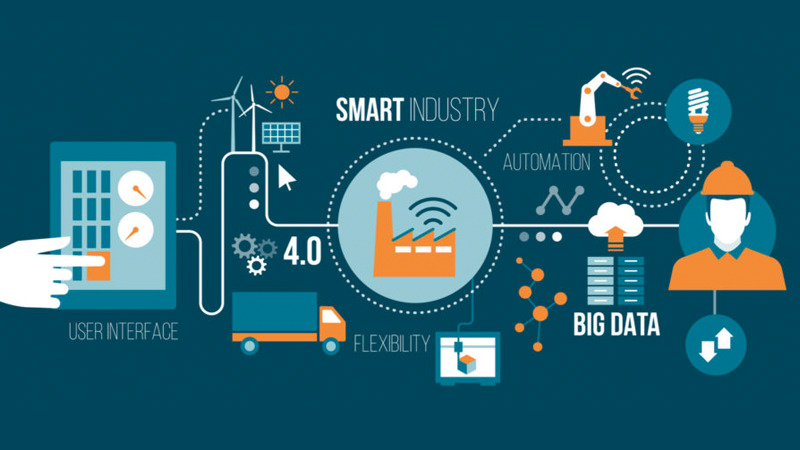
Smart factory
Artificial intelligence - AI: all the data is modeled, then AI applications analyze past data to produce alerts and trends and, at a more advanced level, automatic adaptive adjustments. For example, during production, error data is recorded; when AI is used in producing new goods, it analyzes and compares the new information with the old data and provides feedback for timely changes, saving time and avoiding unnecessary losses.
Introducing SmartBiz IoT - a smart factory and automation transformation solution for traditional businesses
At SBIZ.VN, we offer the SmartBiz IoT solution, including a system of control, monitoring and data collection devices with a wide-reaching network. This digitization solution suits not only new, modern factories but also long-established factories and traditional businesses, bringing positive change to production.
Beyond technology, SBIZ.VN provides a full range of sensors and data collection and transmission devices that fit many types of machinery, turning many older machines into smart machines.
If your business needs to move gradually to a smart, automated factory model, see our production management solution now or contact our Hotline: 0911741551 for advice and the fastest answers to all your questions!