
Working with a system of figures takes a lot of time and manpower. That is why ERP software was created, integrating resource planning, manufacturing resource planning and finance to optimize business operations and management. So what kind of system is an ERP system? Let's get an overview with Sbiz.vn!
What is an ERP system?
ERP stands for Enterprise Resource Planning. It is a software solution for planning resources in businesses and organizations.
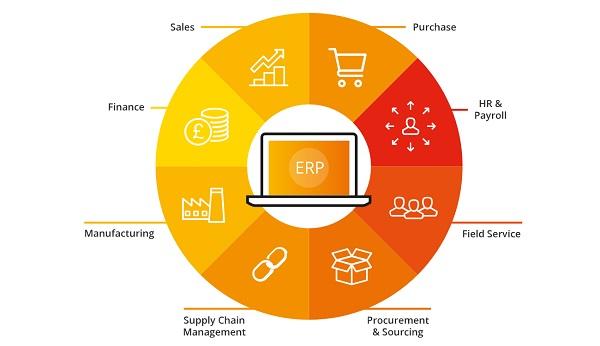
ERP systems
ERP software can be seen as the “king of software”, bringing together all the other “specialist software” such as customer relationship management (CRM), accounting, HR management, warehouse management...
History
The term ERP was first used by the Gartner Group in the 1990s to include manufacturing resource planning software (MRP) and its successor, computer-integrated manufacturing (CIM).

The history of ERP systems
Not all ERP systems were developed from the same core manufacturing principles. Gradually, ERP systems added finance and accounting, maintenance and HR management functions.
By the mid-1990s, ERP systems had integrated all of a business's main functions.
The functions of an ERP system for businesses
An ERP system covers all the functions of a business's activities, including these typical functions:
Planning and budgeting
Sales and customer management
Manufacturing
Quality control
Control of materials, warehouses and fixed assets
Purchasing and supplier control
Finance and accounting
HR management
Research and development
Integrating all of a business's activities into one system (ERP) means all of its resources and data can be well controlled and managed.
How are ERP systems applied in business management?
With so many advantages, ERP has become, and will continue to be, the best business management system of the future.
With an ERP system, labor productivity is improved because time is saved on data entry. Input is entered once and used for many management purposes across the whole system, instead of being entered separately in each management software as before.

ERP systems integrate many applications in a business
Good information control: information from every department flows into one source, making retrieval fast. It can be shared with other parties such as customers and shareholders...
Inventory control: ERP systems also help businesses control inventory, product quantities and the condition of goods in the warehouse. Synchronizing with warehouse data makes management easy, so superiors can track warehouse status and make timely decisions.
Greater competitiveness: ERP systems create consistency in the business. When a change happens in one department, other departments can see the situation and respond. A consistent business coordinates smoothly, works effectively and productively, grows stronger and becomes more competitive.
Good staff control: the state of staffing - who is working, who is off; who is performing well and who isn't; each person's arrival and departure times; other HR indicators... - is all shown in the ERP system. Superiors can use it to assess part of the company's situation.
How will an ERP system improve, optimize and transform your business?
The information each department needs now becomes shared information (with, of course, some information kept confidential within each department), and people in other departments can also see information from your department.
First, ERP optimizes order processing. When customer service (CRM) staff enter an order into the ERP system, they have all the information needed to complete it. Order status is also updated throughout the system and can be viewed by anyone in any department.
However, introducing NEW software (an ERP system) into a business can challenge OLD thinking. People are used to old processes and ways of working and are comfortable with them. Having to learn new processes and do new things, which are sometimes not to their liking, can become an obstacle for them and for the business or company. And if people in the company don't wholeheartedly support the new system, positive change will be hard to achieve.
>>> Lessons for overcoming digital transformation failures.
Conclusions on ERP systems
ERP is an overall business management system that integrates information from every department and unit. ERP systems help businesses observe, track and control their operations and plan their upcoming strategy.
ERP helps businesses keep good control of information, warehouse status, staff, order processes... and above all increases competitiveness, making the business more confident against its competitors.
Wanting to support and help businesses change and transform to grow further, SmartBiz (Sbiz for short) offers the SmartBiz ERP software solution, integrating CRM management software; sales; purchasing; smart warehouse; manufacturing.
If your business would like a demo or to learn more about ERP systems, please contact our Hotline 0911741551 for direct advice or fill in the consultation request form and we will get back to you as soon as possible!