Efficiency has never been more important for manufacturing than it is now.
This is especially true in regions with higher business costs that put many manufacturers at a competitive disadvantage against global counterparts in places such as China, India, Indonesia and Vietnam.
How can manufacturers maximize productivity and minimize waste enough to stay competitive in the global market? For many, the answer is a set of principles and practices collectively known as Lean Manufacturing.
Toyota: what made this famous carmaker so successful? Let's find out in this article!
Main contents
An overview of Lean Manufacturing
2. The 5 principles of Lean Manufacturing
3. The 8 wastes in lean manufacturing
4. 7 tools for Lean Manufacturing
6. Benefits of lean manufacturing
An overview of Lean Manufacturing
What is Lean Manufacturing?
Lean manufacturing is a methodology focused on minimizing waste in production systems while maximizing productivity. Waste is considered anything that customers don't believe adds value and aren't willing to pay for. Some benefits of lean manufacturing can include shorter lead times, lower operating costs and improved product quality.
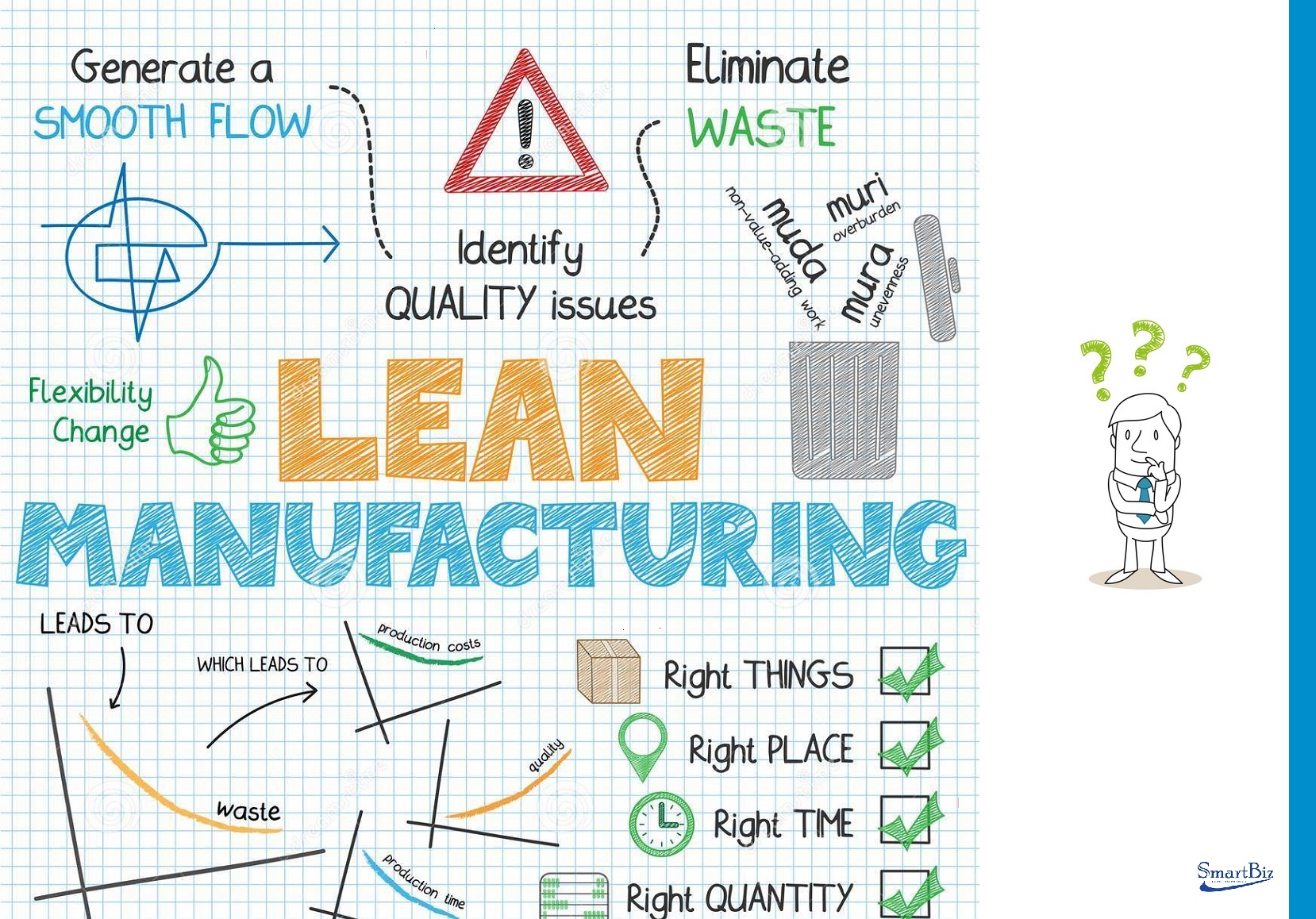
Lean Manufacturing
Lean manufacturing has its roots in Japanese manufacturing and the Toyota Production System. The lean principles pioneered by Toyota include “just-in-time” production, in which inventory is kept low and supplied “as needed”; human-supervised automation to maintain quality control (known as jidoka); minimizing downtime and transport; and others.
Lean manufacturing was introduced to the Western world through the 1990 publication of The Machine That Changed the World, based on an MIT study of the future of the automobile that detailed Toyota's lean production system. Since then, lean principles have profoundly influenced manufacturing concepts worldwide, as well as industries outside manufacturing, including healthcare, software development and services.
The methodology is based on the Toyota Production System and is still used today, by Toyota and countless other companies. Companies using enterprise resource planning (ERP) can also benefit from using a lean manufacturing system.
The 5 principles of Lean Manufacturing
A widely referenced book, Lean Thinking: Banish Waste and Create Wealth in Your Corporation, published in 1996, set out five principles of lean that many in the field consider the core principles. They are value, the value stream, flow, pull and perfection. These are now used as the basis for implementing Lean.
1. Define value from the customer's perspective
Value is created by the producer, but it is defined by the customer. Companies need to understand the value customers place on their products and services, which can help them determine how much customers are willing to pay.
The company must strive to eliminate waste and cost from its business processes so it can reach the customer's optimal price - delivering the highest profit for the company.
2. Map the value stream
This principle involves recording and analyzing the flow of information or materials needed to produce a specific product or service, with the aim of identifying waste and methods of improvement. Value stream mapping covers the product's entire life cycle, from raw materials to disposal.
Companies must examine each stage of the cycle for waste. Anything that doesn't add value must be eliminated. Lean thinking recommends aligning the supply chain as part of this effort.
3. Create flow
Remove functional barriers and identify ways to improve lead times. This helps ensure processes run smoothly from when an order is received until it is delivered. Flow is crucial to eliminating waste. Lean manufacturing relies on preventing interruptions in the production process and enabling a harmonious, integrated set of processes in which activities move continuously.
4. Establish a pull system.
This means you only start new work when there is demand. Lean manufacturing uses a pull system instead of a push system.
Push systems are used in manufacturing resource planning (MRP) systems. With a push system, inventory needs are determined in advance and products are manufactured to meet that forecast.
However, forecasts are often inaccurate, which can lead to swings between too much and too little inventory, as well as subsequently disrupted schedules and poor customer service.
Learn more How did Thegioididong build its ‘massive’ ERP system?
In contrast to MRP, lean manufacturing is based on a pull system, in which nothing is bought or produced until there is demand. Pull relies on flexibility and communication.
5. Pursue perfection through continuous process improvement, also known as Kaizen.
Lean manufacturing is based on the concept of continuously striving for perfection, which requires targeting the root causes of quality problems and addressing and eliminating waste across the entire value stream.
The 8 wastes in lean manufacturing
The Toyota Production System identified seven wastes: processes and resources that don't add value for the customer. These 7 wastes are:
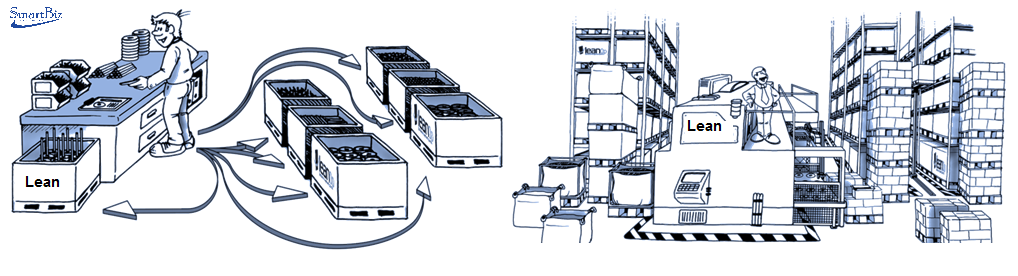
Waste in production
· Unnecessary transportation;
· Excess inventory;
· Unnecessary motion of people, equipment or machinery;
· Waiting, whether people waiting or equipment sitting idle;
· Overproduction of a product;
· Over-processing, or spending more time on a product than the customer needs, such as designs that require high-tech machinery for unnecessary features; and
· Defects, which require effort and cost to correct.
The 8th waste: although not originally included in the Toyota Production System, many lean practitioners have added an eighth waste: wasted talent and unused ingenuity.
7 tools for Lean Manufacturing
Lean manufacturing requires a relentless pursuit of reducing anything that doesn't add value to the product - that is, waste. This makes continuous improvement, which lies at the heart of lean manufacturing, a must.
Other important concepts and processes Lean relies on include:
1. Heijunka:
Leveling or smoothing production to create a continuous production flow, releasing work to the plant at the required pace and avoiding interruptions.
2. 5S:
A set of practices for organizing the workspace to create efficient, effective and safe areas for workers and to prevent wasted effort and time. 5S emphasizes organization and cleanliness.
3. Kanban:
A signal used to streamline processes and create just-in-time delivery. The signal can be physical, such as a card or an empty bin, or sent electronically through a system.
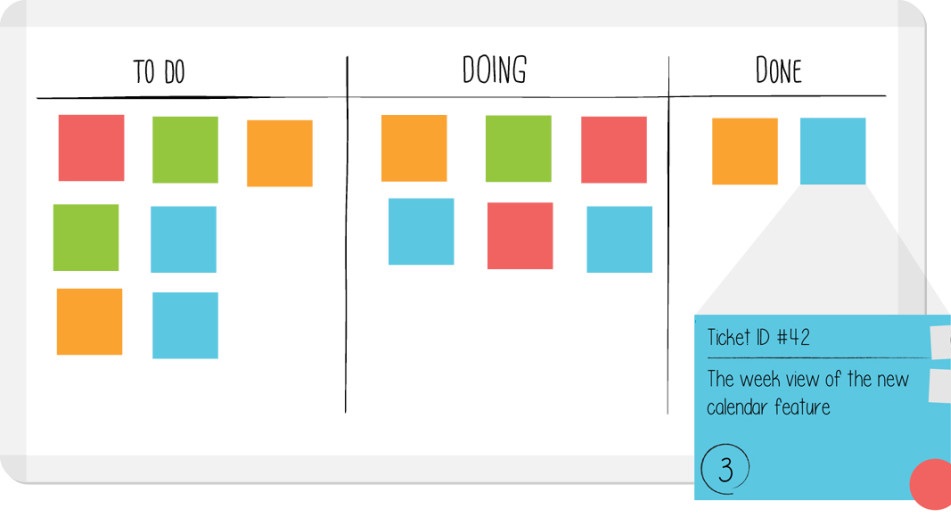
Kanban work status cards
4. Jidoka:
A method that defines an outline for detecting abnormalities, stopping work until they can be corrected, solving the problem and then investigating the root cause.
5. Andon:
A visual aid, such as a flashing light, that alerts workers to a problem.
6. Poka-yoke:
A mechanism that guards against human error, such as an indicator light that turns on if you miss a required step, a signal given when a bolt has been tightened the right number of times, or a system that blocks the next step until all previous steps are completed.
7. Cycle time:
How long it takes to produce a part or complete a process.
Lean vs. Six Sigma
Six Sigma is a data-driven management approach, similar in nature to Lean, that aims to improve quality by measuring how many defects there are in a process and eliminating them until there are as few defects as possible.
Both Lean and Six Sigma seek to eliminate waste. However, they use different approaches because they address different root causes of waste. See also Best practices in smart production management
Put simply, while Lean holds that waste is caused by extra steps, processes and features that customers don't believe add value and won't pay for, Six Sigma holds that waste results from process variation. However, the two approaches complement each other and have been combined into a data-driven approach known as Lean Six Sigma.
Benefits of lean manufacturing
Lean manufacturing improves efficiency, reduces waste and increases productivity. The benefits are therefore wide-ranging:
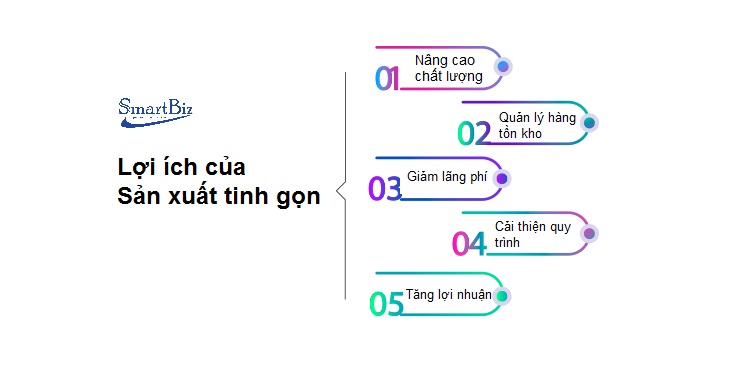
Better product quality:
Improved efficiency frees up staff and resources for innovation and quality control that were previously wasted.
Improved delivery times:
When production processes are streamlined, businesses can respond better to fluctuations in demand and other market variables, resulting in fewer delays and better delivery times. Learn more How 5,000+ large businesses successfully build smart warehouses
Sustainability:
Less waste and greater adaptability leave a business better equipped to thrive in the future.
Employee satisfaction:
Workers know when their daily work is cumbersome or weighed down by unnecessary tasks, and it hurts morale. Lean manufacturing not only increases productivity but also increases employee satisfaction.
Higher profits:
And of course, higher productivity with less waste and better quality ultimately makes for a more profitable company.
[Case study] Toyota and Lean Manufacturing
Introduction
The term Lean in a manufacturing environment also refers to the Toyota Production System established by Toyota Corporation. Within the organization, four well-known gentlemen are credited with developing the system: Sakichi Toyoda, who founded the Toyoda Group in 1902; Kiichiro Toyoda, Sakichi Toyoda's son, who headed automobile manufacturing from 1936 to 1950; Eiji Toyoda, managing director from 1950 to 1981 and chairman from 1981 to 1994; and Taiichi Ohno, the father of the Kanban system.
The foundations of lean manufacturing
Lean Manufacturing was originally called “Just-in-time production”; it was built on the approach created by Toyota's founder Sakichi Toyoda, his son Kiichiro Toyoda and engineer Taiichi Ohno.
Toyota's founders drew heavily on the work of W. Edwards Deming and the writings of Henry Ford. When these men went to the United States to observe the assembly lines and mass production that had made Ford rich, they were not very impressed. While shopping in a supermarket, they observed the simple idea of an automatic drink dispenser: when a customer wants a drink, they take one, and another replaces it.
Toyota got its inspiration for this system not from the American auto industry (at the time by far the largest in the world) but from a visit to a supermarket. This happened when a Toyota delegation (led by Ohno) visited the United States in the 1950s.
The delegation first visited several Ford Motor Company car plants in Michigan, but although Ford was the industry leader at the time, they found many of the methods used were not very efficient. They were mainly appalled by the large amount of inventory on site, by the uneven amount of work done in different departments of the plant on most days, and by the large amount of rework needed at the end of the process.
However, on a later visit to Piggly Wiggly, the delegation was inspired by the way the supermarket only reordered and restocked goods once customers had bought them. Toyota applied the lesson from Piggly Wiggly by reducing the amount of inventory it held to only what its employees would need for a short period, and then reordering. This would become the forerunner of the now-famous Just-in-Time (JIT) inventory system
While low inventory levels are a key result of the Toyota Production System, an important element of the philosophy behind it is working smartly and eliminating waste so that inventory is no longer needed. Many American businesses, after observing Toyota's plants, began attacking high inventory levels directly without understanding what made those reductions possible. Imitating without understanding the underlying concept or motivation may have led to the failure of those projects.
The Toyota Production System is a comprehensive production management technology that the Japanese invented a hundred years after opening up to the modern world. The basic idea of the system is to maintain a continuous flow of products in factories in order to adapt flexibly to changes in demand. Achieving such a production flow is called Just-in-time production, meaning producing only the necessary units in the necessary quantities at the necessary time. As a result, excess inventory and excess workforce are naturally reduced, achieving the goals of increased productivity and lower costs.
The basic principles of the Toyota Production System (TPS) are embodied in the Toyota Way.
Goals of the Toyota Production System (TPS)
The main goals of TPS are to design out overburden (muri) and inconsistency (mura), and to eliminate waste (muda). The most significant effects on delivering process value are achieved by designing a process capable of delivering the required results smoothly; by designing out “mura” (inconsistency). Seven types of waste are addressed in TPS:
1. Overproduction. Learn more The essential guide to accurate inventory planning
2. Motion (of operators or machines)
3. Waiting (of operators or machines)
4. Transportation
5. Over-processing
6. Inventory (raw materials)
7. Correction (rework and scrap)
Eliminating muda has dominated many people's thinking when they look at the effects of TPS because it is the most familiar of the three approaches. In TPS, many initiatives are implemented by reducing mura or muri, which eliminates muda without specifically focusing on reducing it.
Toyota Motor's core principles
The basic principles, known as the Toyota Way, were set out by Toyota as its core principles as follows:
1. Continuous improvement
· Challenge: We form a long-term vision, meeting challenges with courage and creativity to realize our dreams.
· Kaizen: We continuously improve our business operations, always driving innovation and evolution.
2. Respect for people
· Respect: We respect others, make every effort to understand each other, take responsibility and do our best to build mutual trust.
· Teamwork: We stimulate personal and professional growth, share opportunities for development and maximize individual and team performance.
3. Long-term philosophy
Base your management decisions on a long-term philosophy, even at the expense of short-term financial goals.
4. The right process will produce the right results
· Create continuous process flow to bring problems to the surface
· Use “pull” systems to avoid overproduction
· Level out the workload. (Work like the tortoise, not the hare.)
· Build a culture of stopping to fix problems, to get quality right the first time
· Standardized tasks are the foundation
· for continuous improvement and employee empowerment
· Use visual control so no problems are hidden
· Use only reliable, thoroughly tested technology that serves your people and processes.
5. Add value to the organization by developing your people and partners
· Grow leaders who thoroughly understand the work, live the philosophy and teach it to others.
· Develop exceptional people and teams who follow your company's philosophy.
· Respect your extended network of partners and suppliers by challenging them and helping them improve.
The Toyota Production System is likened to wringing water from a dry towel. This means it is a system for thoroughly eliminating waste. Here, waste refers to anything that doesn't advance the process - everything that doesn't add value.
Many people decide to eliminate the waste that everyone recognizes as waste. But much of the rest simply hasn't been recognized as waste, or people are willing to tolerate it.
People have resigned themselves to certain problems, become hostages to routine and abandoned the habit of solving problems. Going back to basics, exposing the real significance of problems and then making fundamental improvements can be seen throughout the Toyota Production System.
6. Lean implementation systems and methods
A production line that adapts to changes in demand in terms of quantity and variety is created by achieving two key concepts: Just-in-time and Autonomation. These two concepts are the pillars of the Toyota Production System. Just-in-time basically means producing the necessary units in the necessary quantities at the necessary time. Autonomation (“Jidoka” in Japanese) can be understood as autonomous defect control. It supports Just-in-time by never allowing defective units from a previous process to flow into and disrupt the next process.
Two other concepts that are also key to the Toyota Production System are flexible workforce (“Shojinka” in Japanese), meaning varying the number of workers as demand changes, and creative thinking or inventive ideas (“soikufu”), or capitalizing on workers' suggestions.
To realize these four concepts, Toyota established the following systems and methods:
· The Kanban system to maintain Just-in-time production. Read more How important is the Just-in-time model in modern manufacturing?
· Production smoothing methods to adapt to changing demand
· Shortening initial production setup time
· Standardizing operations to achieve line balancing.
· Machine layout and multi-skilled workers for a flexible workforce
· Improvement activities by small groups and suggestion systems to reduce the workforce and raise worker morale.
· Visual control systems to achieve the idea of autonomation
· Functional management systems to promote company-wide quality control.
Alternatively, the TPS system is often depicted as a house, known as the House of TPS, in which:
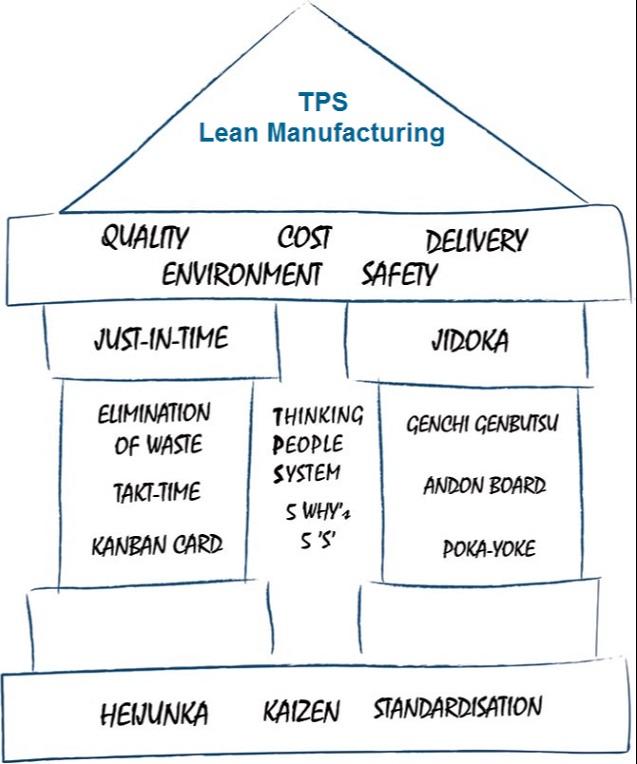
Toyota Lean Manufacturing
Mái nhà
The roof represents the goals of TPS. Quality, delivery price, market, safety - everything must be the best, the fastest and the most timely.
Pillars
The pillars supporting the roof of TPS are Just-in-time and Jidoka.
· Just-in-time (JIT): focuses production and transport on what is needed, just in time and in sufficient quantities. There is no room for producing goods that don't sell.
· Jidoka: Jidoka should be distinguished from automation. Jidoka is automated production combined with checking for problems and finding ways to fix them, whereas automation is continuous automatic production regardless of whether there are defects.
· The conditions for implementing JIT and Jidoka are leveling and harnessing ingenuity to solve the obstacles one by one.
Other tools commonly found in production systems, such as Andon System, Poka-Yoke, 5 WHY, 5S,…
Móng nhà
In the House of TPS, it includes tools that help stabilize and sustain production. These include: Heijunka (leveling), KAIZEN and Standardized Work. KAIZEN is the methodology and foundational philosophy of LEAN, meaning continuous improvement.
Toyota says the key to the system is that it taps into the knowledge and deep insight of team members while giving them a great deal of training and responsibility. Only by harnessing its employees' creativity can Toyota continuously improve.
7. The results Toyota achieved with the Toyota Production System
The Toyota Production System, and more importantly its core elements “Kanban” and “Jidoka”, have not encountered many problems that directly threatened the existence of the Just-in-Time system at Toyota.
About 20 years later, Toyota rose to become the world's largest carmaker. Consumers recognized the quality of Toyota cars, and the “bandwagon effect” made Toyota famous. Toyota cars were more durable and needed fewer repairs than American cars.
To this day, nearly 100 years after its founding, Toyota remains among the most profitable carmakers, far ahead of Ford, continually launching high-quality models with little labor and extremely low inventory holding times.
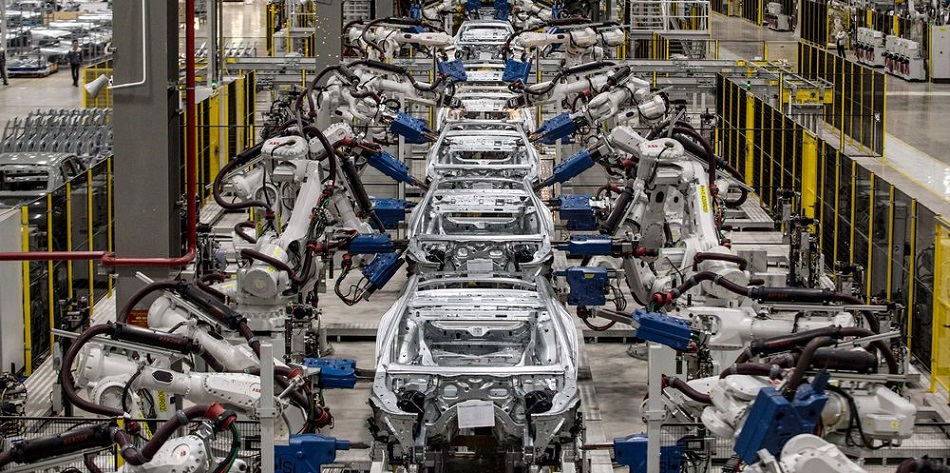
Toyota car manufacturing
Conclusion
In high-speed production, everything is moving. Machines, people, funds and materials are always in motion. So inventory in the warehouse or in the shops is ‘moving’ rather than ‘standing still’. The conditions for high-speed production include flow production, line balancing, level scheduling and linearity.
Clearly, Toyota and its application of Lean Manufacturing are doing something right. As any business leader knows, success doesn't happen by chance. It is the result of commitment, passion and the pursuit of excellence.
You have had a great look at the secrets of Toyota's success. As experts in smart business management solutions and smart factories, we believe it is valuable to you. But there's more: if your production system needs advice on lean manufacturing, why not explore SmartBiz? You can book a survey or request a demo to see how SmartBiz can optimize your production management.
Before you leave the page, let us know in the comments whether this content was useful to you.