In the modern business environment, "adaptability" is the ability to adjust your approach or actions in response to changes in the external environment. In software specifically, an adaptable system is one that doesn't need to be redesigned to maintain a high level of performance.
Along with each business's growth come challenges in managing the business. Typically, each business owns one or more systems made up of many IT applications. Over time, as needs change and the business grows, the demands placed on these systems rise too.
How are businesses facing this challenge? And what is the optimal solution? Let's answer these questions through a typical real-world case from a manufacturing business whose system had not kept up with its growth and business requirements.
Main contents
About the business
LSS Vietnam Co., Ltd. is a foreign-invested company founded in 1997, and is the leading electrical panel manufacturer in Vietnam. It is a member of LS Group, a world leader in smart energy.
The company has its headquarters and factory in Dong Anh and offices in Hanoi, Hai Phong, Da Nang and Ho Chi Minh City.
The company specializes in manufacturing and assembling medium- and low-voltage industrial switchboards, control panels, distribution boards, electrical equipment and electrical apparatus. Today LSS Vietnam has become a leading domestic company in manufacturing medium- and low-voltage switchgear, control and distribution equipment meeting ISO 9001 standards.
The business's difficulties and challenges
It is one of the large businesses pioneering the use of technology to manage and run its operations. The company has been using the Ksystem ERP software, applied uniformly from the parent company to its Vietnamese company, for more than 10 years.
The ERP software handles everything from sales to purchasing, inventory, accounting and manufacturing; however, the warehouse management and manufacturing parts now have many shortcomings and are not truly optimized. Customizing this system and maintaining it with patches and upgrades is complex, costly and consumes critical time and resources.
For manufacturing, the company manages everything from manufacturing orders to BOMs, but does not yet manage progress in detail down to each stage of production; all progress updates are recorded based on people.
Specifically, for warehouse management, the company handles all warehouse operations entirely by hand, such as: receipts and issues, stock counts and warehouse location management. In the ERP software, the warehouse management module doesn't go into detail on warehouse operations. Based on the production orders requesting materials in the ERP software, the warehouse department carries out material issue and receipt orders. This is entirely manual and is stored and managed in Excel files, and then, once completed, the data is entered into the software.
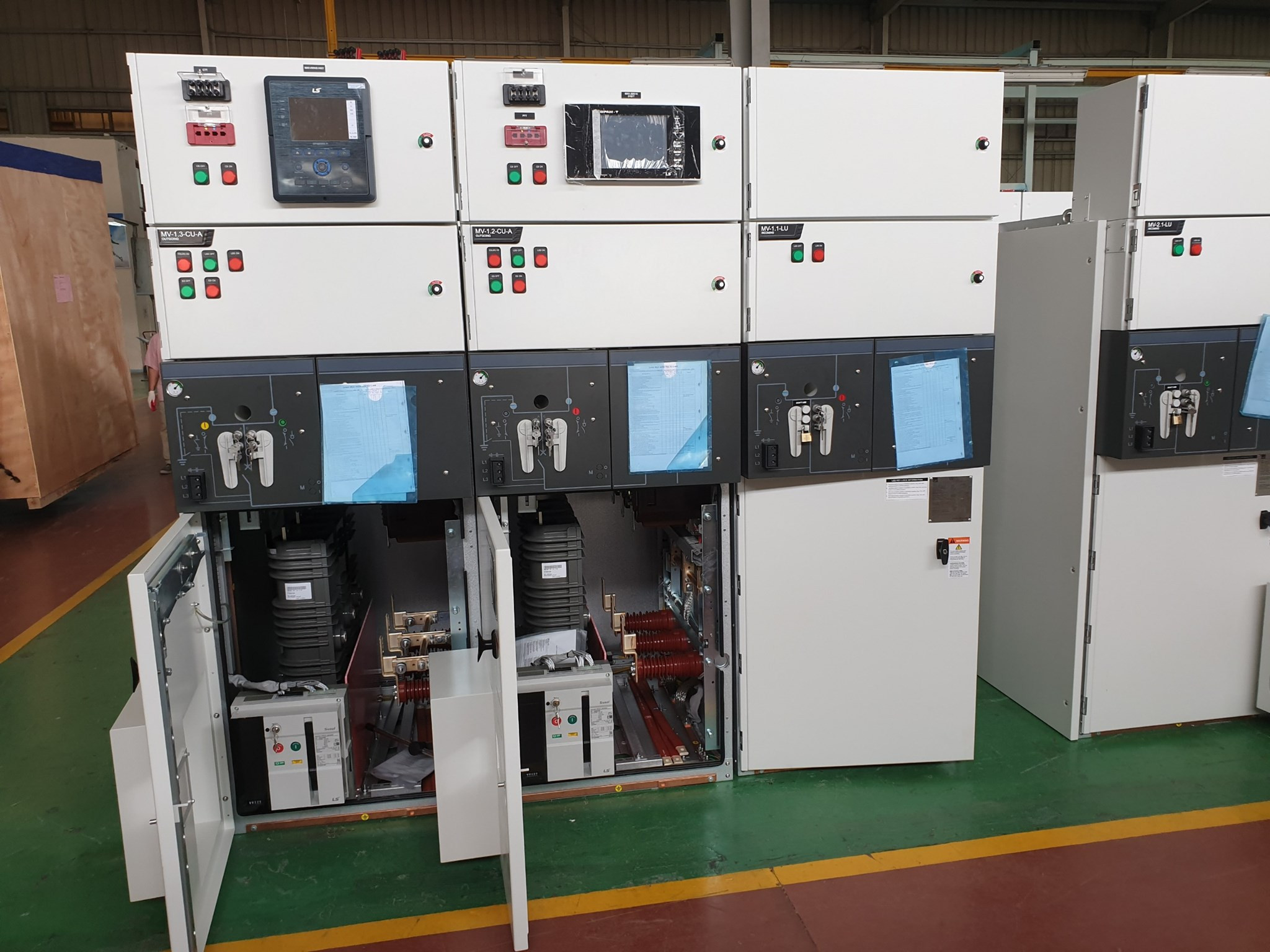
The business's products
The customer's materials warehouse is quite large, with about 2,000 types of materials of all kinds and of high value, while the storage space is small and insufficient, partly because warehouse locations had not been planned, so materials were scattered across many locations in the factory. As a result:
Warehouse locations had not been planned, making management difficult; when materials went missing, staff had to search every location to find them.
The warehouse is large, the warehouse workforce is insufficient, and management is manual, causing work overload and making it impossible to manage everything.
Manual receipts and issues depend heavily on people, leading to problems such as production staff going to the warehouse to take goods but forgetting to tell the warehouse department, or the warehouse department being too busy to manage everything and entering incomplete data into the software. These factors led to material discrepancies during stock counts.
Difficulty with stock counts: the company does count its goods, but the figures are often wrong. The warehouse holds more than 2,000 types of materials, but after counting, only 70% were correct; the rest currently don't match the figures on paper.
In the factory's production stage, the customer wanted to manage the quantity of semi-finished goods after production but had no way to do so.
Khám phá: Best practices in smart production management
The optimal implementation solution to the customer's problems
To solve the business's problems while reducing the risk of changing all of the customer's operations and processes, saving human resources and time and fitting the investment budget, SmartBiz proposed a phased implementation plan, including:
Smart warehouse management app:
Helps the business control the receipt, issue and stock of goods, limiting errors, shrinkage and loss of goods;
Speeds up processing of purchase, sales and manufacturing orders with inventory alerts.
Smart, fully automated warehouse management that avoids the errors of manual operation.
Data is aggregated and reported in real time, letting users manage the current warehouse status.
Implement a comprehensive warehouse management solution, from the materials warehouse to the production warehouse.
Barcode app:
Integrates with the inventory app to speed up receipts, issues, checks and stock counts and minimize human error;
Implement warehouse location planning managed with barcodes to arrange the warehouse scientifically and logically.
Khám phá ngay: How to manage a warehouse with barcodes effectively
For future expansion requirements such as centralizing and unifying all data on one platform and optimizing operations, SmartBiz can advise on implementation in subsequent phases.
In terms of approach, SmartBiz implements in 2 phases:
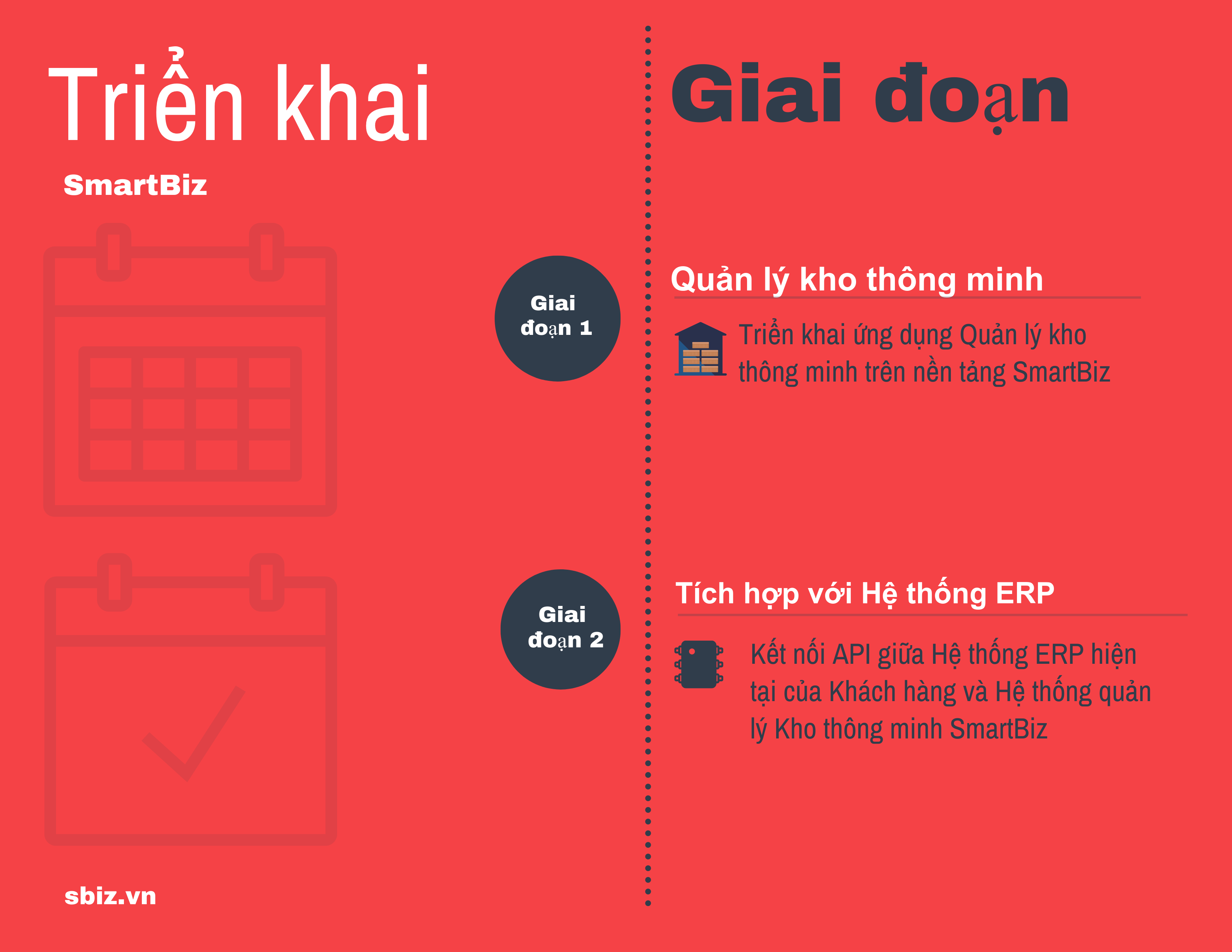
SmartBiz implementation approach
Phase 1
First implement the smart warehouse management module on the SmartBiz platform to immediately solve the current warehouse management problems, including:
Managing receipts and issues with barcodes, recording information in the software automatically. This increases work efficiency and minimizes risk.
Managing and re-planning warehouse locations with QR codes, making it easier to find goods and compile statistics.
A software-based stock counting feature that solves the problems the customer was facing, producing accurate, clear and truthful figures.
For warehouse management in production, it manages the materials going into production and the semi-finished goods produced.
Phase 2
SmartBiz integrates, via API, the SmartBiz smart warehouse management software with the customer's existing ERP solution, so that:
Data in the warehouse management software is already standardized according to the business's operating processes, so exporting the data needed to integrate with the business's ERP system is easier.
Integrating with the existing ERP system also makes it easy for the business to manage the factory's operating processes as one unified flow, with automation in the production process.
Data between the 2 software systems is exchanged and recorded synchronously in the system.
Benefits the customer gained from the solution
With conventional management that relies on people to solve the management problem, it is very hard for a business to optimize efficiency. For a company trying to adapt, the right technology can give it better visibility and control. By investing wisely in technology, companies can achieve all these benefits and more.
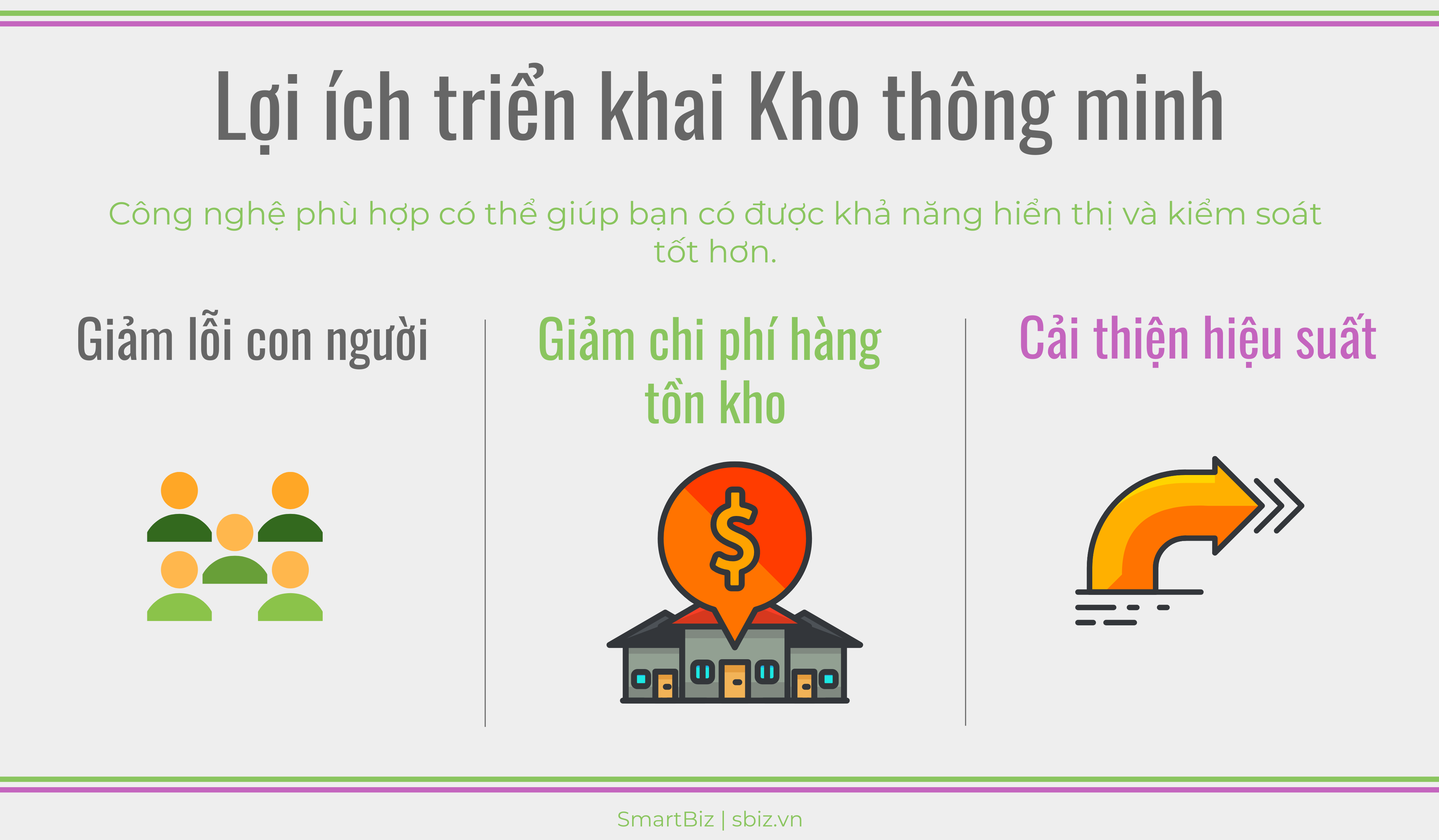
Benefits of implementing smart warehouse management
Reduced human error:
The software helps tightly control the business's processes, limiting staff errors, reducing the time spent on reports and making it easy to trace back when errors occur.
Quick, barcode-based management of receipts and issues, minimizing errors in data entry.
Lower inventory costs:
Optimizing how the warehouse is managed and arranged makes managing, tracking and counting inventory easy and fast, reducing loss and shrinkage of inventory.
Managing storage locations by cell and shelf compartment with QR-coded locations increases data accuracy and reduces data entry time.
Khám phá: How do 5,000+ businesses manage smart warehouses effectively?
Improved performance:
Maximum automation of business processes through integration between the SmartBiz smart warehouse management software and the customer's existing ERP system.
Departments can coordinate and interact with each other on the same system.
Reports updated in real time
Frequently asked questions (FAQs)
5 signs that you are ready to use an ERP system:
#1: You have different software for different processes.
#2: You can't easily access information about your business
#3: Sales and the customer experience are struggling
#4: Accounting is taking longer and getting harder
#5: Your IT system is complex and time-consuming
One of the biggest disadvantages of having multiple systems in a business is that IT management can become a nightmare. When customizing these systems, integrating them and maintaining them with patches and upgrades becomes complex, costly and consumes critical time and resources, an ERP system should be considered.
· ERP systems eliminate data silos in the business, letting data from each department flow automatically to and integrate with other departments.
· ERP systems can eliminate manual processes, especially data entry and analysis.
· ERP can streamline business processes to make them more efficient and more profitable.
· ERP can manage the whole business in a single system instead of many systems.
· Cloud-based ERP can stay up to date on a consistent basis, ensuring the business has access to the latest features instead of worrying about upgrading to new versions.
· ERP can be costly and complex. If an ERP system doesn't meet your business's requirements, it can be difficult to get an ROI from the software.
· An ERP can be difficult to implement, not only in installation and configuration but also in training and guidance for end users.
· On-premise ERP systems can be costly to maintain, especially when the solution is old and has been customized to work around software problems.
Conclusion
Decision-makers know they need a management system that can grow with them. Losses and shrinkage can quickly pile up, and your inventory can cost more than it is worth if you don't optimize your management processes. ERP systems that include production management, smart warehouse management and much more are a common need for digital transformation.
Is this something you are interested in right now, and would you like a similar optimal solution? If so, contact SmartBiz now and get advice and support from our experts as soon as possible!