![[Customer Story] ERP Implementation: The Difficulties, Challenges, and Benefits for Businesses](/web/image/blog.post/59/author_avatar/%5BCustomer%20Story%5D%20ERP%20Implementation:%20The%20Difficulties%2C%20Challenges%2C%20and%20Benefits%20for%20Businesses?unique=52c7c69)
If you are considering implementing ERP to manage your business, let's look with SBiz.vn at the story of our customer Tham Tam - the Tham Tam - TN trading and production enterprise - to better understand the difficulties, challenges and benefits they experienced before and after adopting an ERP system.
Should you implement ERP?
About the Tham Tam - TN trading and production enterprise
The Tham Tam - TN trading and production enterprise was founded and began operating in January 2008, specializing in wholesale and retail of construction equipment, supplies and materials such as aluminium, plastic ceiling panels, gypsum...
The business is headquartered in Bac Ninh and currently owns 2 separate stores and 5 warehouses, along with more than 10 trucks of different capacities for distributing goods.
How was the ERP software system applied?
The business is growing strongly and keeping up with market demand. As a result, wholesale orders distributed to dealers and construction sites have increased, averaging several hundred a day, and there are so many retail orders they can't even be counted. This made it difficult for the business to calculate accurately how many orders had been issued, received, sold...
So would implementing ERP really deliver results for the business in this case?
The difficulties and challenges the business faced
As a long-established business, all of its management activities were run manually: basic Excel and paper ledgers, with almost every order entered by hand.
This manual management caused the business many difficulties and inevitable risks of losing goods, and it couldn't manage how much stock it had or how much was received and issued.
Furthermore, business processes weren't standardized and there was no consistent way of working, so everyone did things their own way, leading to overlapping, uncontrolled work.
The business has now expanded to 2 stores and 5 warehouses in different locations, so managing goods has also become difficult:
No inventory management - not knowing exactly which products were in stock, which were short and which had been lost.
No detailed tracking of product types and specifications, since there are many items with different specifications - color, size, weight - so stock levels for each specific item weren't known.
Large volumes of sales and purchase orders come in every day, while the sales software couldn't handle selling by weight or converted units of measure.
Retail price lists change frequently, while prices were updated and calculated manually outside the system.
Revenue was an estimate that often differed between reality and the figures in the sales software and Excel spreadsheets...
A typical example in order management: as a wholesaler and retailer of construction materials, the business frequently ran into unit-of-measure conversion issues. When selling, it depended on staff using a calculator to convert units into money.
For example, aluminium received from the factory is priced by color and weight, but when sold to customers it has to be converted into m2 and multiplied out to calculate the price.
Operations were managed manually without a set sequence, so reports were not carried out or tracked accurately.
The business then started looking for an ERP software system.
So what was the solution to this problem?
Based on our analysis of the customer's current situation and our experience, the customer needed to solve 2 main problems:
1. Business processes need to be standardized.
2. A software solution to help the business, through automated tools working in real time, run smoothly. This reduces the management burden and delivers better sales and customer service.
SmartBiz proposed a right-sized solution, implemented in phases to help the customer gradually change habits and adapt to the system, with 3 modules: Purchase, Sales and Inventory Management, in which

How the ERP system was implemented
Purchase: helps the customer standardize its purchasing process with suppliers and keep the entire purchase history. It compiles purchase orders with suppliers and accurately reports the number of orders purchased at different times.
Smart inventory management: helps the customer manage products and goods more easily, synchronizing product data from 2 stores and 4 warehouses in the same software system for management.
● Product data is managed and classified by product group and by internal code as well as supplier code, making it easy for the business to look up and find products.
● The software standardizes the unit of measure for each type of product in stock, making unit conversion when receiving and selling goods easier, so users don't spend time calculating conversions by hand before selling. Stock alerts help the business quickly reorder products that are running low.
Sales: the software helps the business manage everything from product quotations to creating orders for customers. It records the entire history of sales orders and previous selling prices, making management more effective and avoiding missed orders or mistaken figures when processing sales orders.
The ERP system saves the business time
An overview reporting interface for the whole process helps the business grasp its business situation and reports on products, inventory... All reports are shown in real time, timely and completely accurate.
>>> The top 5 reasons ERP software dominates businesses
What were the results after implementing the software?
Here are screenshots of the actual software after the customer implemented ERP:
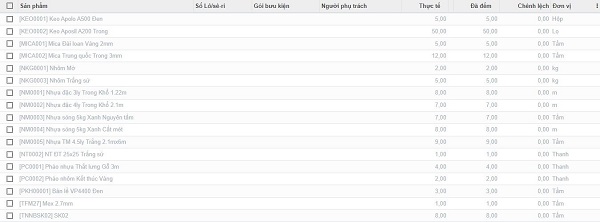
Screenshot of the product list

Screenshot of detailed figures on selling price, cost price, actual product quantities...
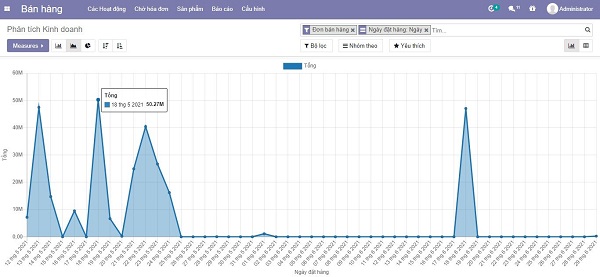
Screenshot of sales figures shown in charts
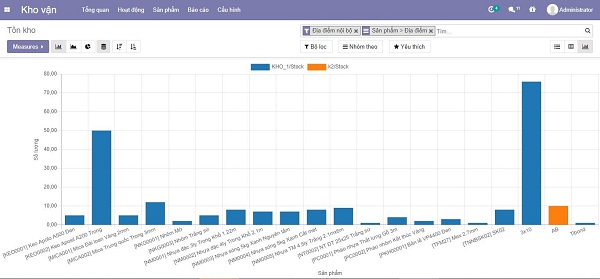
Screenshot of warehouse figures shown in charts
We hope this information on how ERP is implemented helps you understand better and decide whether to adopt an ERP software system for your business. SBiz.vn is proud to provide solutions that help businesses overcome difficulties in managing orders, inventory... Contact us now for more details!