Today, the manual food processing industry is undergoing significant change due to pressure from ever fiercer competition and ever higher consumer demand. To meet these challenges and achieve the best production efficiency, businesses need to apply modern, smart management solutions: comprehensive production management connecting the customer to the warehouse, optimized production processes and simplified work for operators to delight customers.
6 trends in food processing production management: process automation and end-to-end integration.
1. Stronger performance management:
The food processing industry is focusing on optimizing production efficiency and resource use. Businesses need to closely track performance indicators such as output, waste and machine downtime to ensure smooth, efficient operations.
2. Supply chain integration:
To make sure raw materials are always available to meet production needs, supplier management and supply chain integration become important. Production management software must be able to track supply schedules and inventory to avoid shortages.
3. Technology innovation:
Technology keeps advancing and changing how food is produced. Many businesses are moving from manual production to automation and using information systems for management. They need software that can integrate with automation equipment and provide real-time information.
4. Safety and quality requirements:
Food safety and quality are critical. Production management software must be able to track and manage safety and quality standards, ensuring the final product always meets these requirements.
5. Data and analytics:
Businesses are increasingly aware of the importance of data in business decision-making. Software needs to collect and analyze production data to provide key information that helps managers make sound decisions.
6. Integration with warehouse management:
Inventory management together with production management plays an important role in ensuring enough stock to meet market demand. Software needs to integrate with the warehouse management system to track and adjust inventory effectively.
Outstanding benefits manufacturers can achieve
Comprehensive production management solutions bring you many surprising benefits. Statistics show that businesses using modern food processing production management software can achieve outstanding benefits compared with manual production:
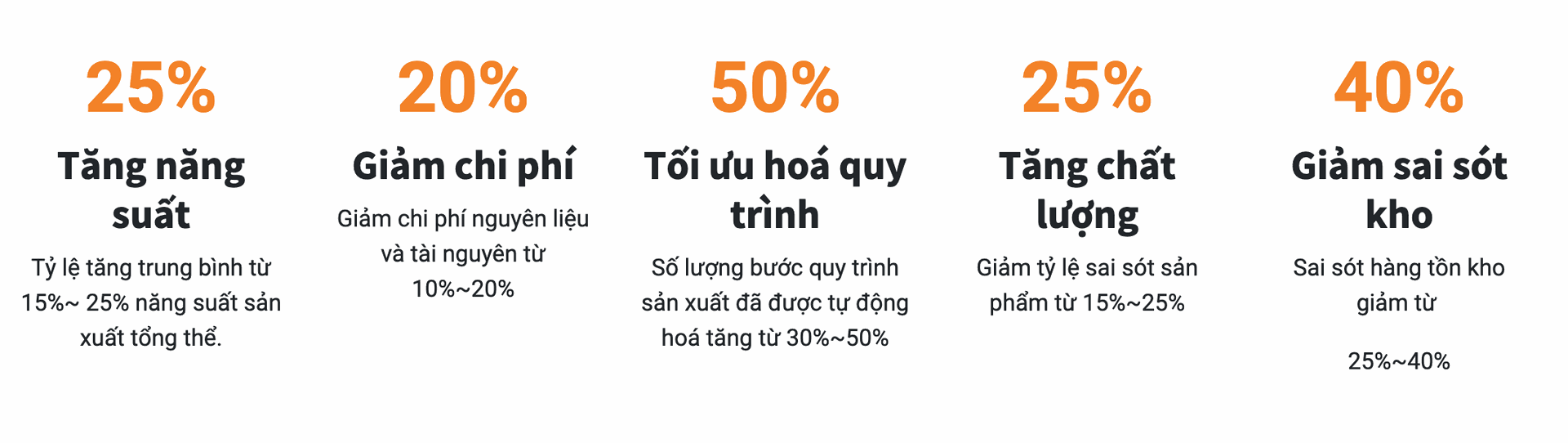 Benefits manufacturers can achieve
1. Higher productivity:
An average increase of 15~25%: applying smart, modern production management usually raises productivity through process optimization, better resource use and improved production planning.
2. Lower costs:
Optimizing production processes and resource use can cut waste and production costs by 10%~20%. Effective inventory management also helps avoid excess stock and save costs.
3. Automated processes:
Integrating automated processes into food processing reduces human error. It also increases process consistency and efficiency.
4. Higher product quality:
Product defect rates down 15%~25%. A smart production management system can help control quality during production, resulting in higher-quality final products that better meet customer requirements.
5. Fewer inventory errors:
Inventory errors down 25%~40%. Smart production management software tracks inventory more accurately and efficiently, helping avoid excess stock, reduce shortages and cut inventory errors.
Khám phá: The secrets of smart, effective warehouse management
Specific figures and benefits may vary depending on the situation and the business. For more detailed information and specific statistics, consult research reports and organizations related to the food processing industry.
5 requirements modern food processing production management software must meet:
1. Comprehensive production management and process optimization:
A good production management system must be able to connect the entire production process from the customer to the warehouse. The software should help optimize processes, reduce waste and increase productivity. Simplifying production processes should also be a priority to make operators' work easier and reduce errors.
2. Customer connectivity and order management:
The software needs to connect with customers through easy-to-use interfaces, letting them order directly and track the status of their orders. This builds better customer relationships and improves demand forecasting.
3. Supplier and purchase order management:
The software needs to manage the supplier list and track stock levels and purchase orders. This ensures a stable supply and reduces the risk of material shortages.
4. Smart connection between production and the warehouse:
The management system needs to create a smart connection between the production process and warehouse management. Tracking production status and stock levels makes it possible to adjust production to actual demand and avoid excess stock.
5. Customer satisfaction:
All the factors above serve the ultimate goal of ensuring customer satisfaction. Managing production processes and orders well ensures products always meet the required quality and delivery times.
To meet these requirements, food processing production management software needs features such as order management, supplier management, inventory tracking, production planning and performance reporting. Easy-to-use interfaces, real-time data integration and flexible customization are also points to consider so the software can adapt well to each business's specific needs.
Conclusion:
Trends in food processing production management are gradually shifting toward smart solutions and automation. End-to-end integration and smart technology optimize production processes, enable flexible responses and create transparency in the food processing industry. This not only strengthens competitiveness but also delivers added value to customers and the market.