
The 4.0 revolution has affected not only industry: agriculture too is developing at a dizzying pace. Applying IoT (Internet of Things) in smart agriculture has helped raise agricultural productivity and output by 7-15%, even in places affected by climate change. So how is IoT applied in smart agriculture? Let's look at the information below with Sbiz.vn!

How is IoT applied in smart agriculture?
According to Nhan Dan newspaper: “Over the past decades, although agriculture has grown relatively fast, it still hasn't solved global ‘food security’. According to forecasts, the world population will reach 9.6 billion by 2050, 25% more than today. Agricultural production therefore needs to increase by about 70% to meet demand by then. To serve this population well, agriculture must embrace IoT.”
To better understand how IoT is applied in smart agriculture, read on!
The current state of Vietnamese agriculture
Opportunities and challenges
Favorable natural conditions and geographical location have given Vietnamese agriculture abundant irrigation water and a wide variety of crops and livestock. However, Vietnam also faces many difficulties, such as natural disasters, storms, floods and saltwater intrusion... The Mekong Delta is an important trade gateway and transit point for goods bound for the Asia-Pacific.
In the era of integration, businesses are expanding globally, and there are structural shifts from staple food crops to vegetables and aquaculture. Consumers increasingly choose organic, environmentally friendly products. Vietnam's agricultural export market is viewed positively but faces many difficulties as world agricultural prices fluctuate unpredictably.

What are the challenges facing Vietnam's agriculture?
The achievements of Vietnamese agriculture
In 2019, products such as wood, vegetables, fruit, shrimp and cashews each had export turnover above US$3 billion, placing them among the country's 8 highest-earning export goods.
Recognizing the difficulties of small-scale production, local businesses have built value chains linking key products together. The Mekong Delta is a typical example, with a rice value chain linking 10,000 rice-growing households.
Besides investing in and developing small and medium-sized businesses, large groups and corporations are also stepping up investment in high-tech agriculture, such as Vinamilk, Lavifood, Ba Huan...
Through tireless effort, learning and applying technology in agricultural production, and linking production and consumption in chains, the country now has nearly 3,000 large-scale field models.
What is smart agriculture?
Smart agriculture (agriculture 4.0) is agriculture that applies high technology (automation, mechanization...), production technologies that ensure product safety (GAP, GlobalGAP, organic...), and management and chain-based product identification technologies linked to AI (artificial intelligence) systems.

What is smart agriculture?
The benefits of IoT
IoT is seen as the key to success in the near future, with a positive impact on life and work. As in industry, applying IoT in agriculture promises unprecedented benefits, such as:
Superior efficiency
Agriculture today is in a race. Land is shrinking, while world demand for food is rising sharply, soil is degraded by unscientific production practices and weather is becoming ever more volatile.
IoT in agriculture lets farmers monitor produce and growing conditions in real time. IoT collects information quickly, can predict problems in advance and supports smart decisions and preventive measures. In addition, IoT in agriculture enables automated production processes, such as demand-based irrigation and fertilization and automated harvesting robots.
Expanding agricultural coverage
By the time the world population reaches 9 billion, about 70% will live in urban areas. IoT-based greenhouse and hydroponic systems make it possible to supply food such as fruit and short-cycle vegetables to city dwellers.

Smart agriculture delivers superior efficiency
Resource-rich
With the ability to optimize the use of water, energy, land resources… applying IoT in smart agriculture helps farmers allocate precisely the resources needed for crops to grow and develop.
Cost savings
Clean farming models that apply IoT to production not only help farmers save water and energy but also make crops greener and fresher, minimizing the use of pesticides and fertilizers.

Just connect your phone to Wi-Fi
Improving produce quality
With 24/7 care from IoT applications in particular and smart agriculture in general, produce quality has been raised and the nutritional value of products increased.
Applications of IoT in smart agriculture
Applying IoT in smart agriculture is one of the new paths toward digital agriculture in our country. Some applications of IoT in agriculture include:
Canh tác chính xác
Precision farming, also called precision agriculture, is everything that makes farming and the control of livestock and crops more precise. In this farm management approach, the key is using information technology and items such as sensors, control systems, robots, automated hardware and variable rate technology...
Precision farming is one of the best-known applications of IoT in agriculture today.

Automatic irrigation systems
Livestock monitoring
Large farm owners can use wireless IoT systems to collect data on the location and health of their livestock. This information helps them identify sick animals so they can be separated from the herd in time, preventing the spread of disease. IoT systems reduce labor costs, because farmers can locate their livestock with the help of IoT-based sensors.
Smart greenhouses
Growing plants in greenhouses is one of the effective ways to increase the yield of vegetables, fruit and crops... Greenhouses control environmental parameters through manual intervention or proportional control mechanisms. Smart greenhouses designed with the help of IoT control the greenhouse climate without manual intervention.
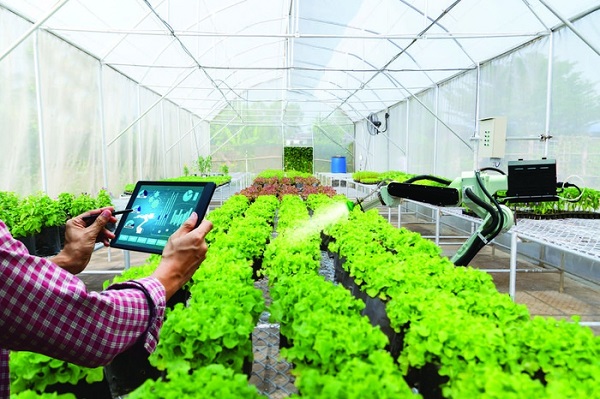
Greenhouse vegetable growing
We hope this article has helped you better understand the benefits of applying IoT to smart agriculture. We wish you the best direction for the project you are carrying out; please contact Sbiz.vn if you want to bring an IoT system into the project for your business.