Is the new PaperLab paper recycling system, with customizable thickness, size and color, really the key to helping businesses save costs and boost productivity? To understand this new business solution in more detail, let's read the following article with Sbiz.vn!

Do new business solutions applied to the printing industry really drive economic development?
About Epson PaperLab
Epson Southeast Asia (Epson SEA) officially marked its move to new regional headquarters at Alexandra TechnoPark, Singapore, with the launch of its special PaperLab paper recycling system.
Epson SEA's new headquarters has two new solution centers, letting partners and customers in the region explore suitable, environmentally friendly products and solutions for businesses. These solutions are Epson's sustainable innovations in printing, visual imaging and robotics, as well as its dry-process office papermaking system (Epson PaperLab).
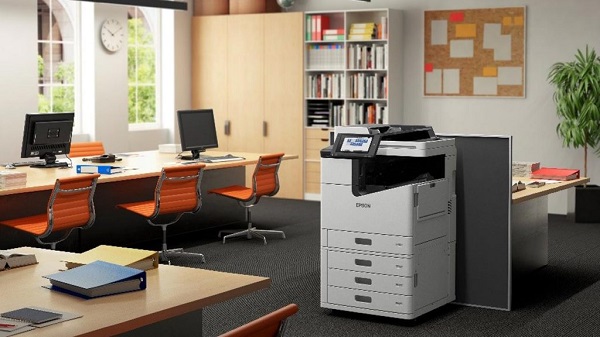
A new business solution – Epson PaperLab
The launch of Epson's revolutionary PaperLab paper recycling system marks an important milestone in Epson's journey; this is a business solution aimed at promoting the “circular economy”.
How has automation changed Epson PaperLab?
PaperLab is an in-office papermaking system applying Epson's Dry Fiber technology that uses absolutely no water in the process. The solution uses unique technology, completely different from traditional paper recycling methods. It is currently on display at Epson's new business solution center in Singapore.
With this unique technology, the printer doesn't need to generate heat to warm up, saving businesses time with fast printing speeds. Furthermore, this printer line uses fewer replacement parts and consumables, reducing user intervention and contributing to optimizing the production management process.
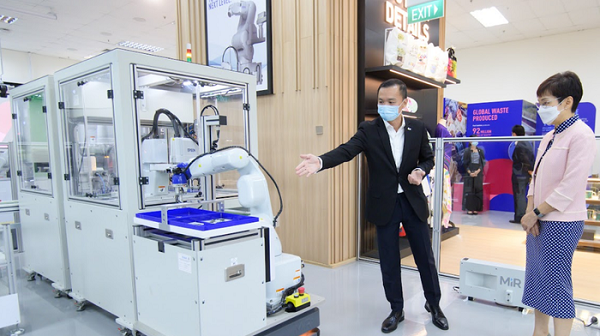
Business solutions – automating the production process
The machine can now increase speed and customize the thickness, color and size of the new paper. This recycling process has 3 stages: separating, binding and forming. In the paper recycling process, the system removes ink and toner and turns shredded paper into fibers. This keeps the business's information and confidential documents safe.
Besides PaperLab, the solution centers at Alexandra TechnoPark also showcase Epson product lines such as business inkjet printers, scanners, projectors, point-of-sale (POS) solutions and large-format printers for industrial label printing, photo printing, advertising printing and textiles.
Applying industrial solutions to the printing industry – a new business solution
Some applications of industrial solutions in the printing industry include:
Exclusive Heat-Free Technology
The exclusive heat-free printing technology built into the printers uses no heat during printing, so it consumes less power than laser printers. The advantage of this technology lies in its heat-free ink ejection process, which uses Epson's Micro Piezo inkjet technology to set it apart from other inkjet printers.
Epson's main goal is to help businesses switch from laser and analog printing to environmentally friendly inkjet printing and from lamp-based projectors to laser projectors, automating manual production processes with AI – a powerful ally for businesses.
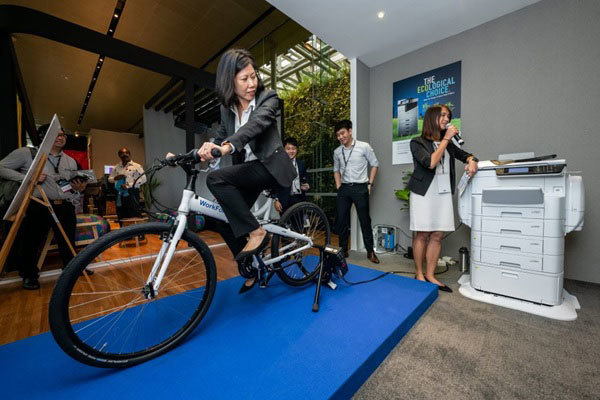
Heat-free printing technology – a business solution
The in-office paper recycling process
This new business solution has also shown that it is the world's first in-office paper recycling process that uses no water. Using Dry Fiber technology, PaperLab turns used paper into new paper in under 3 minutes and uses about 1/100 of the water needed to produce the same amount of paper. This helps businesses both save water and reduce the volume of paper that has to be shipped to recycling plants.
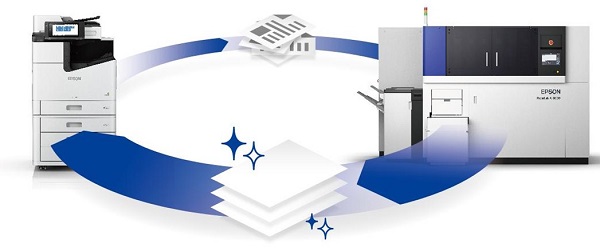
The paper recycling process
Benefits include:
Cost savings.
Protecting resources.
Saving energy.
Reducing wastewater discharged into the environment.
Reducing solid waste and CO2 emissions.
Reducing environmental pollution.
Reducing the number and area of landfills.
Heat-free printing solution (Epson WorkForce Enterprise WF-C20590)
The new heat-free inkjet printers use 85% less energy and emit 85% less CO2 than laser printers. As a result, the number of parts needing replacement is also 59% lower.
Running these new business solutions well requires applying IoT in production, helping businesses reduce operating costs and improve performance and labor productivity. IoT makes it possible to control and monitor all of a company's processes and to control equipment remotely through supporting software.

Applying IoT in production
Furthermore, IoT stores valuable information so managers can easily access and analyze data quickly without having to go to the production site in person.
>>> Learn about Lineage Logistics' digital revolution.