
When implementing total productive maintenance (TPM) in a business, evaluating OEE always comes first. So what is OEE? OEE is a metric that helps businesses identify problems in using and maintaining assets, so they can make continuous, effective improvements. To understand this metric better, let's explore it in detail with Sbiz.vn in the following article!
OEE là gì?
Many businesses don't clearly understand what OEE is or how to use it. In fact, OEE stands for Overall Equipment Effectiveness. So OEE can be understood as a metric used to calculate the operating effectiveness of a machine or piece of equipment.
Businesses use OEE to measure the quality, uptime and operating speed of machinery. This helps managers improve how effectively machinery is used by optimizing its parameters.
What is OEE?
Today, OEE is regarded as a comprehensive way to calculate the production effectiveness of equipment. A business whose plant runs efficiently has a high OEE. Conversely, a low OEE means the business's revenue is being eroded, possibly with major losses. Understanding what OEE is helps businesses adjust and improve how their machinery performs.
How to calculate overall equipment effectiveness
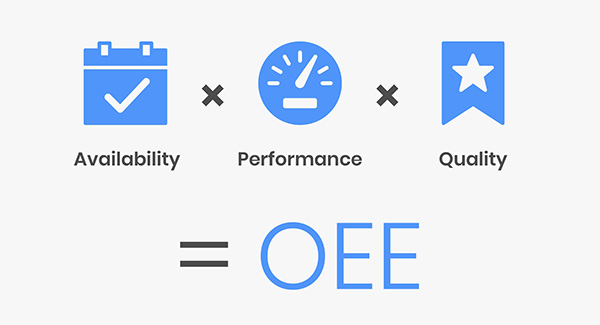
To know how to calculate OEE, you need to understand what the OEE metric means. OEE depends on 3 factors: availability (A), quality (Q) and performance (P).
Based on these 3 factors, overall equipment effectiveness (OEE) is determined by the following formula:
Where:
Availability: measures losses in operating time.
Availability = (Actual operating time / Planned run time) x 100%
Quality: measures quality losses.
Quality = (Total good products / Total products produced) x 100%
Performance: measures losses in operating speed.
Performance = (Total products produced) / (Actual run time x Design capacity) x 100%
What is the formula for OEE?
Here is an example of how to interpret these parameters:
Availability = 97%: the business uses 97% of its time resources, and the remaining 3% is downtime compared with the equipment's operating potential.
Quality = 95%: for every 100 products made, 95 meet quality standards and the remaining 5 don't. Or for every 100 hours of production, 5 hours are wasted on quality-related issues.
Performance = 90%: this figure shows that the equipment's actual production capacity is only 90% of its design capacity, and the remaining 10% is lost time.
The main causes affecting OEE
What losses affect OEE? The common causes are as follows:
Breakdown stops: losses from the machine stopping or its function degrading.
Setup and adjustment: losses related to setting up machinery to change or adjust production.
Replacing parts and equipment: losses related to replacing equipment that wears out over the course of production.
Start-up and shutdown: speed and output losses during machine start-up and shutdown.
Interruptions and idling: capacity losses due to minor stoppages of undetermined duration or the machine running idle.
Speed losses: losses in machine speed (tons/hour) when the machine runs below its design capacity.
Scrap and rework: losses related to damaged, unusable products plus the time and cost of correcting and reworking them.
Planned stops: losses related to planned machine stops (power cuts, stops for PM...). These losses don't affect overall equipment effectiveness. However, they reduce production time, which in turn reduces the output of the equipment or process.

Impacts on equipment OEE
OEE helps reduce 6 losses for businesses
Thanks to OEE, businesses can eliminate and limit the 6 big losses - the main causes of reduced performance in production. So what are the losses related to OEE? They can be listed as follows:
Equipment and machinery breakdowns.
Equipment setup and adjustment.
Minor stops during equipment operation.
Equipment running at reduced speed.
Start-up defects.
Production defects.

The big losses in OEE